
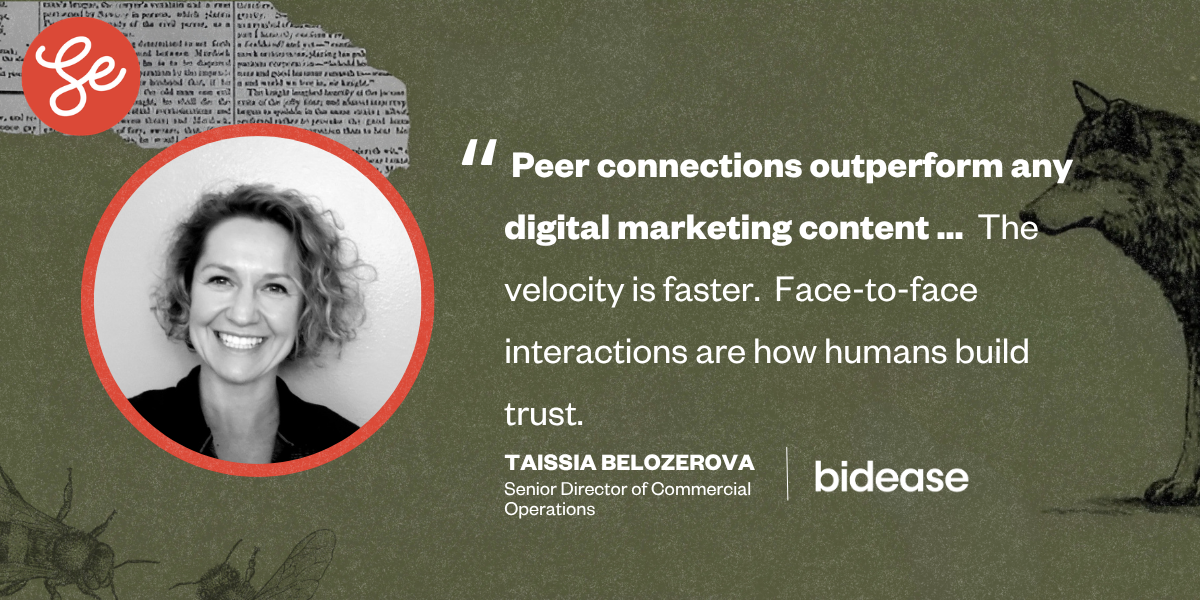
Analytics and gut checks both have their place, but real beauty is where they meet in the middle
Disclaimer: The opinions represented here are those of the individual and do not necessarily represent those of their current or former employer.
B2B buyers are more informed, and possibly more skeptical, than ever. It takes pros like Taissia Belozerova, a veteran marketing operations savant, to cut through the noise and reach prospects. But for Taissia, it’s not enough just to hit a bullseye. The real magic happens when you can call your shot from a mile away, leveraging data to say where and when your messaging will have an impact. Splendid Engines sat down with Taissia for a recent interview.
Watch the full interview below, or read on for a selection of key takeaways.
Key Takeaways
- Craft focused narratives with parsable themes. Make your customer the hero and address their pain points in ways they can easily understand.
- Showcase content featuring your customers’ experiences. Leveraging community content signals that you understand customer needs and builds social proof.
- Turn relationships into a growth engine. Genuinely care about your customers and actively encourage word-of-mouth referrals.
- Balance data-driven decisions with gut instinct. Remember the strongest marketing strategies blend metrics with human insight for agile decision-making.
- Build processes that let a small team scale. Invest in agile marketing operations so you can execute at high volume without burning out.
Frame Your Customers As Heroes in Focused Stories
It’s tempting for B2B marketers to trumpet product features and specs. But Taissia emphasizes that even technical buyers respond to clear, value-driven storytelling over feature checklists. She noted that while data and tools have made marketing more sophisticated, fundamental psychology still rules. The priority is to make your customer the hero of the story, to show you understand their problems and can solve them, rather than bragging about your product’s bells and whistles.
“When we tell a story, we focus on a specific message that’s easy to understand. It’s not about listing all the cool features... Why should a customer work with us? Because we actually listen and strive to provide specific value.”
These stories don’t need to be complex to work. Salesforce is a great example: Instead of just enumerating CRM features, Salesforce’s marketing often spotlights customer success stories where clients are the main characters. It breaks each story into a simple Challenge, Action, Result structure, and positions itself as the peppy sidekick to its partner’s success. This testimonial-driven storytelling creates trust and shows Salesforce as a guide, resulting in content that is “far more engaging” and credible to prospects. By focusing on how they solve real business challenges (in customers’ own words), Salesforce taps into the emotional impact of outcomes, not just technicalities.
Elevate Your Community’s Voice to Build Trust
One of the standout lessons from Taissia’s experience is the power of peer-driven content. In an age of buyer skepticism, people trust people, especially those in similar roles or industries, more than they trust brands. Taissia helped build Liftoff’s Mobile Heroes program, which showcased interviews and stories from customers and industry peers. The community-first philosophy has carried through to her current work at Bidease, where the team runs Bagel Train. It's a program that brings seasoned industry experts together to share latest experiences, spark strategic discussions, and yes, enjoy some delicious bagels. There isn’t a product pitch. The programs are about adding value to the community.
“We started our community program not to make us look good, but to help the industry grow. We found people doing great work and got them to tell their story so others could hear it and try those ideas. Marketing should provide a lot of value. It’s not about extracting value from customers, but giving value: storytelling, sharing insights; helping people connect and grow.”
This community-centric mindset can pay huge dividends. When your marketing features genuine expert voices, buyers intuitively feel that you understand their world. For example, Gainsight cultivated a thriving customer community of over 10,000 members who participated in Community Unplugged, a virtual event replete with knowledge swaps and innovative strategy sharing. Gainsight takes the opportunity to take in feedback, develop its roadmap, and build richer relationships with its customers, all while building brand loyalty.
If you’re thinking about how to build something similar, Splendid Engines can help. We partner with B2B companies and launch community content programs that create real connection and long-term brand equity. Whether it’s interview series, community reports, or persona-driven campaigns, we’ll help you bring your audience into the story. Contact us today.
Turn Referrals into a Growth Engine
All the slick digital campaigns in the world struggle to match the impact of a sincere referral or a face-to-face relationship. Buyers are far more likely to respond to a colleague’s recommendation than a cold outreach. In Splendid Engines’ own survey data, we found that 83% of B2B decision makers would move through a purchasing decision faster if they learned about the vendor through a trusted peer. That lines up with Taissia’s experience: She’s regularly observed that leads coming through referrals or community channels move faster than those from standard marketing tactics.
“I believe that people are at the heart of this industry. When you invest in real relationships that's when ideas and projects actually grow. Face-to-face interactions are how humans build trust.”
To harness referral leads, make it easy and rewarding for your happy customers to refer others. Structured referral programs can systematically turn customer goodwill into new business. Slack gained early traction in big companies by small teams adopting it and then spreading it internally, essentially peer endorsement doing the selling. The key is to treat relationships as an extension of your sales team. Every delighted customer or industry friend is potentially your most credible salesperson, because they bring trust through the door with them.
Balance Data with Gut Instinct in Decision Making
In an era of analytics and AI, marketing leaders have no shortage of data to guide decisions. Taissia is highly analytical, you’d be hard-pressed to find anyone more adept with HubSpot or Salesforce, but one of her major lessons is not to lose the human element. There’s a creative intuition in marketing that pure numbers can’t replace and AI hasn’t. At least not yet. Especially in new or rapidly changing markets, you sometimes have to trust your experienced hunch on what messaging will resonate or which bold campaign to try, even if historical data isn’t there yet. Taissia frames it as combining the “art and science” of marketing.
“The longer you’re in marketing, the more you build up intuition. Gut checks are part of every decision. I always start with the numbers, see what the data is telling me, and then factor in what the numbers can't yet see.”
In practice, this means using data as a decision support, not a decision maker. For instance, you might see in your metrics that a certain content topic isn’t performing, but your gut tells you it’s a growing pain point for customers. The best marketers will probe that intuition and run an experiment, rather than blindly sticking only to past proven topics. Apple’s Steve Jobs famously relied on gut feeling about consumer needs, then used data from pilot users to adjust course. B2B leaders can do the same by trusting seasoned instinct to innovate, while still measuring results and iterating.
Build Process to Let a Small Team Do Big Things
Perhaps one of the most impressive insights from Taissia’s career is how much a lean team can accomplish with the right systems in place. At Liftoff, Taissia, along with her team, managed a huge scope – from 60+ events a year to continuous reports, webinars, and a global community program – all with a marketing team of under ten people. The secret wasn’t superhero working hours. It was having scalable processes and clarity in operations. By standardizing workflows and automating where possible, they reduced ad-hoc decision fatigue and execution errors, allowing the team to focus on high-impact work.
The instinct for scalable systems now drives her work at Bidease, where she owns commercial operations across GTM, revenue, and customer success and is rebuilding the commercial team's operating system with AI at every layer. "If the system is working," she says, "no one has to spend time thinking about the system."
Atlassian scaled globally with virtually no sales team. Their marketing processes (and product-led growth model) did the heavy lifting to turn trials into enterprise deals. Whether it’s a modern automation tool, an editorial calendar, or a clear division of roles, investing time in building a repeatable system is a force multiplier. It enables consistency, frees your team from reinventing the wheel, and ensures you can seize opportunities without chaos. Process is power for a small marketing team.
Develop Your Instincts With Community Insights
Taissia’s insights boil down to a new B2B marketing ethos, one that blends the human touch with smart systems. Make your customer the hero, amplify voices from your community, and cultivate referrals. These lessons are especially relevant for B2B marketers navigating crowded markets and skeptical audiences. By applying them, you can build a marketing engine that not only generates leads, but also earns lasting trust and engagement.
Ready to put these lessons into practice? Splendid Engines helps you to create community-driven content programs and data-informed strategies that achieve just that. Contact us today.
Comments