
Ted explains why businesses that invest in their community and let customers do the talking are more likely to succeed
Disclaimer: The opinions represented here are those of the individual and do not necessarily represent those of their current or former employer.
As B2B buyer journeys become longer and more self-directed, decision makers are increasingly turning to trusted peers for validation before engaging with vendors. That’s why go-to-market veteran Ted Verani’s perspective is so timely. In an interview with Splendid Engines, Verani shared how modern business leaders are flipping the script on traditional sales and marketing by turning to community-led sales initiatives to grow their presence online and pick up customers along the way.
Watch the full interview below, or read on for a selection of key takeaways.
Key Takeaways
- Prioritize leveraging your happy customers as advocates. Cultivate testimonials and case studies that let customers sing your praises, so prospects hear authentic voices beyond your sales deck.
- Unite sales and marketing around community content. Break down silos between sales and marketing by collaborating on thought leadership and customer stories.
- Focus your early go-to-market on a narrow win. Use that success as a proof point then expand horizontally or into new markets once you have momentum and credibility.
- Lead initial sales yourself, because nobody likes to be sold to. Ditch sales scripts and have an authentic, problem-solving conversation about your solution to close your first customers and learn their needs.
- Encourage customers to connect, share feedback, and even help each other. Over time, an engaged user community will generate referrals, content, and credibility for your brand, effectively doing your marketing for you.
Overcome Your Fear of Asking for Referrals
People habitually seek recommendations from friends and industry colleagues before they ever talk to a vendor or even consult Google. Knowing this, every satisfied customer is a marketing asset. Verani advises teams not to be shy about asking happy clients for a referral or introduction to a peer. Likewise, capture their success in a quote or case study so you can share it with others. By actively leveraging word-of-mouth, you tap into the most powerful customer acquisition channel available.
“As long as you’re doing good work for someone and they’re happy with your product or service, there’s no reason not to ask them for a referral. Lean in on that peer recommendation… Similarly, ask for a reference. Get a quote from them and have marketing turn it into a case study. That’s where sales comes together with marketing.”
Real-world data backs this up. Splendid Engines’ [Placeholder] found that 84% of B2B buyers start the purchasing process with a referral. Referred leads aren’t just more plentiful, they’re often higher quality. They convert at significantly higher rates and stick around longer than leads from other channels. For example, Atlassian famously grew through user evangelism and referrals rather than heavy outbound sales, relying on positive word-of-mouth and customer love to fuel a multi-billion dollar business.
Want to learn more? Get in touch with Splendid Engines to learn how our GTM engine can power your business.
Align Sales and Marketing Through Community Content
One of Verani’s strongest beliefs is that sales and marketing should work hand-in-hand, especially when engaging the broader community of your industry. In his career, he’s often served as a bridge between the two functions, ensuring that marketing efforts closely supported sales conversations. The magic happens when both teams collaborate on content that features industry peers and experts, rather than just the product. Verani recounts modl.ai’s State of Games QA campaign, where the company (alongside Splendid Engines) co-created a report with respected game development professionals. By involving these voices in the content, the company achieved far greater reach and credibility than any standard marketing brochure could.
“We created a piece of content – in this case, a survey – and got input from experts in the field. We picked people with genuine expertise and a good social following… We promoted them as thought leaders, included their insights, and then leveraged their networks as they shared the work. People follow people more than they follow companies, so it amplified our reach and added a halo of trust.”
The State of Games QA campaign, which delivered more than 260 leads and slashed modl’s CPL by 75%, is part of an approach that turns marketing into a community effort. Your contributors feel like partners, and your audience sees content enriched with authentic, diverse perspectives instead of corporate speak. Splendid Engines’ survey [Placeholder] reinforces how powerful this is: 87% of B2B buyers said they’re more likely to engage with a vendor who publishes interviews or content featuring their industry peers. No wonder 67% of B2B brands now use influencer or expert collaborations to increase credibility and brand awareness.
Focus Your Early Efforts to Land and Expand
When entering a new market or launching a new product, focus is your friend. Verani stresses that in the first 90 days of a go-to-market, you should resist the urge to cast a wide net. Instead, narrow your targeting to win a single beachhead. That might mean homing in on one vertical, a specific geography, or a single use-case, whatever slice you can credibly win over quickly. By securing one notable customer or success story, you gain proof points (and confidence) to win more and then expand further.
“In the first 90 days, you want to enter with the wind to your back. One way is narrowing your focus, whether that’s focusing on a specific product offering or a particular vertical or region… It’s all about land-and-expand…Get that first win as quickly as possible, then expand… enter in with a simpler, lightweight solution, then say, ‘By the way, we can also help you with [other things]."
This “land and expand” playbook is a proven strategy for many B2B SaaS companies. Slack is a textbook case: It often entered organizations team by team. A small group of users would start using Slack for free, love it, and invite colleagues, and before long Slack had spread company-wide, leading to an enterprise deal. In other words, Slack landed in one team and then expanded across the org, a pattern that helped it win massive contracts with minimal initial friction.
Approach Founder-Led Sales With Authenticity, Not Scripts
Founder-led sales are a foundational part of success for early-stage companies. They can speak to the problem the company seeks to solve authentically as a community member, Verani says, making it easier to connect with buyers on an emotional level. But to take full advantage of that, founders need to leave behind sales scripts and speak from the heart. As the old adage goes, people don’t buy when they understand a product, they buy when they feel understood. By transforming early sales calls into a problem-solving discussion, founders can instill a sense of understanding in clients that leads to more closed deals.
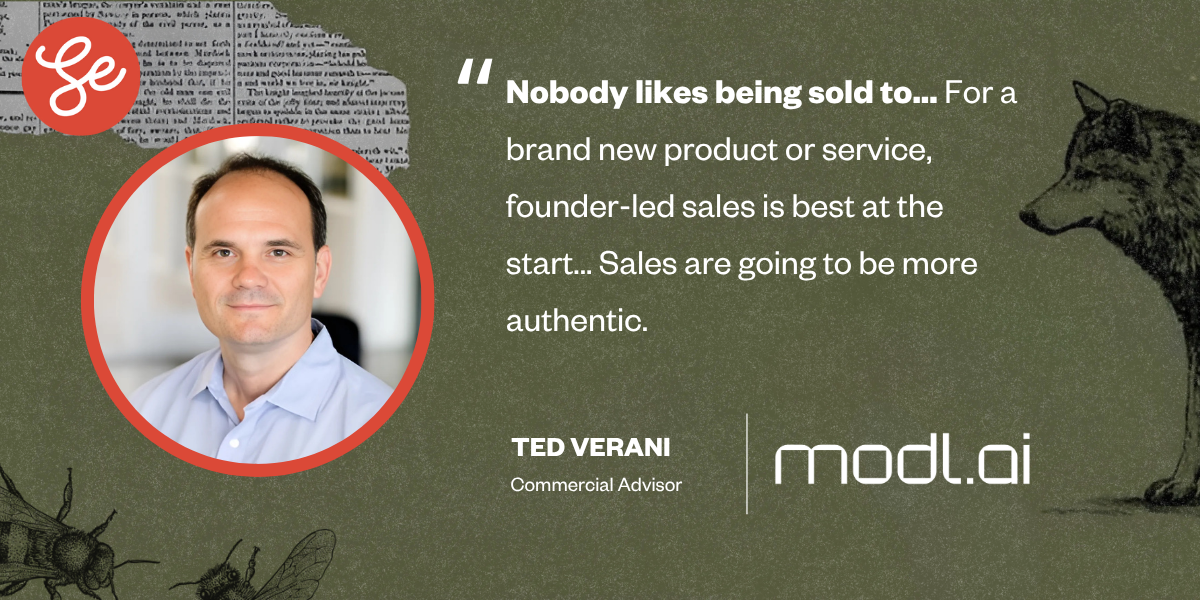
“Nobody likes being sold to… For a brand new product or service, founder-led sales is best at the start. When you have no customers, the person with the original idea deeply understands the problem… A founder talking to a potential customer is more of a problem-solving conversation. Once you’ve landed the first few customers and proven product–market fit, then it’s time to bring in a specialist and scale. But those early wins and the authentic relationships that come with them are something only a founder can do.”
A founder can adapt on the fly, tailor the solution, or even tweak the product roadmap in response to feedback from those early sales meetings. For instance, enterprise SaaS company Lattice grew initially through CEO Jack Altman personally engaging with HR leaders to understand their needs, which not only closed deals but also informed the product’s development. By employing a level of care that a generic salesperson might not have delivered, founders can build long-lasting relationships with prospects that help preserve an organization long-term.
Let Your Community Do Your Marketing
As your company matures, Verani suggests a somewhat radical idea: let your customer community become your most powerful marketing department. We’ve come full circle to the importance of community, but now the focus is on scaling it. By “community,” think of channels like LinkedIn, where professionals can gather to swap advice, share recommendations, and network. If you’ve nurtured this community well (and your product truly delivers value), you’ll eventually reach a point where customers are actively singing your praises, helping onboard others, and even answering questions for prospects.
“Going forward, [community] becomes even more important. I can see us talking less about marketing-qualified leads and more about community-qualified leads. In other words, let your community do your marketing for you. Of course, not in the very early days, you need a critical mass of happy customers first. But once you have that confidence, a solid base of users who love your product, you can lean on them. You’ll see people in channels talking about your solution. Let your customer give a demo to others. Let them champion your product.”
This community-led growth approach is gaining serious traction in B2B. In fact, industry analysts note a surge in companies building dedicated community programs. Gartner reported a 74% jump in inquiries about customer communities from 2022 to 2023. The reason is clear: An active user community drives retention and referrals like nothing else. But to achieve it, you must invest in your users’ success and give them places to congregate. Encourage discussions, highlight community members’ achievements, and listen to their feedback. Verani’s advice is to even track “community-qualified leads” the same way you’d track MQLs. That means recognizing when a prospect was influenced by community content or interactions, and attributing pipeline to those efforts.
Embrace Your Community’s Expertise
Ted Verani’s playbook for B2B growth ultimately revolves around trust. Whether it’s earned through a peer’s referral, a value-packed piece of content, a founder’s genuine conversation, or a vibrant customer community, trust is the currency that accelerates modern B2B deals. The thread uniting all these takeaways is the idea of community-driven strategy: putting relationships and credibility at the center of your marketing and sales efforts.
In a business world increasingly influenced by communities and social trust, those who build and nurture their community will lead the pack. Invest in your community, empower your advocates, and let authenticity fuel your growth. Want help building this kind of expert-led, conversion-driving content? Splendid Engines specializes in content that earns attention and turns it into pipeline. Check us out.
Comments