
Why you should start treating AI as an intern and prioritizing unscalable human conversations right now
Disclaimer: The opinions represented here are those of the individual and do not necessarily represent those of their current or former employer.
The shift to an AI-first marketing paradigm presents marketing leaders with a paradox: the tools offering infinite scale are also eroding the very trust required to convert that scale into revenue. We’ve all received a “personalized” email that still feels generic or gotten an uncanny valley feeling while watching an AI-generated social ad. Anyone can generate thousands of posts with little effort, and buyers are tuning them out. In this environment, the most dangerous thing a brand can do is succumb to the temptation of "average."
While many marketing teams are paralyzed by the fear of being replaced or drowned out, a select group of leaders is realizing that this era of "slop" is a gift for the authentic. Ellen Zarate, Senior Product Marketing Manager at PFU America, Inc., is one of them. By doubling down on human connection while others hide behind bots, PFU is proving that trust is the ultimate competitive moat. We sat down with Zarate to discuss how top-tier marketers can skip the “slop” and build marketing buyers want to engage with.
Watch the full interview below, or read on for a selection of key takeaways.
Key Takeaways
- Split operations to assign AI the "intern" tasks while keeping creative strategy strictly human. This division of labor ensures you gain operational speed without sacrificing the emotional power of your brand voice.
- Prioritize authenticity as much as hard metrics to avoid the "digital insult" of low-quality AI output. In an era of infinite noise, verified human insight is the only currency that builds genuine trust with skeptical buyers.
- Dismantle your content gates to respect the modern buyer's preference for self-guided discovery. Transparent pricing and accessible demos turn your funnel into a flywheel that qualifies prospects before they ever speak to sales.
- Prioritize human conversations to uncover the emotional truths that data misses. While AI can help analyze sentiment, only direct dialogue, like phone calls, can reveal the nuance needed for messaging that hits.
- Build a culture of rapid experimentation to turn market chaos into a competitive ladder. Instead of fearing the volatility of the AI era, encourage your team to test new tools constantly and treat failure as valuable data.
Split Your Stack: AI is the Intern, You are the Architect
The most immediate trap for marketing leadership is the allure of using AI to replace the creative "brain" rather than the operational "hands." Zarate argues for a strict division of labor. In her view, AI should be ruthlessly deployed against the "nuisance" tasks—data cleaning, process interrogation, and structural organization—while the core creative strategy remains deeply human. The danger lies in using AI for key messaging and positioning; when you do this, you are effectively asking an algorithm to regress your brand to the mean of your competitors. By treating AI as a tireless intern rather than a creative director, leaders can reclaim the mental bandwidth necessary to produce the kind of non-derivative, high-empathy work that cuts through the noise.
"I tend to use AI very much for process and interrogation. I'm not a fan of using AI for creative… Your key messaging, your key positioning, where you connect with your audience, that's a human connection… I treat AI more like my intern. What is the task that I absolutely hate? What is the nuisance that takes me away from thinking? What is the pain in the ass that I just don't want to deal with? And that's what I'm going to find a way to offload to AI."
PFU America, Inc., Inc. isn’t the only organization reaping the rewards of this approach. Klarna has executed this philosophy at scale, making headlines for using generative AI to reduce its sales and marketing spend by 11% while simultaneously running more campaigns. The key was their application of the technology: they didn't automate their brand strategy, they automated the "nuisance" of image production. By using AI to generate stock imagery and resize assets, they compressed a six-week production cycle into just seven days and saved $6 million. This allowed their human creative directors to focus on campaign concepts rather than the logistics of photo shoots.
Trust is the New Gold Standard
As AI-generated "slop" saturates our feeds, consumer skepticism has morphed into a defensive crouch. Zarate identifies a critical risk that many data-driven marketers overlook: low-effort AI content is perceived by the buyer not just as noise, but as a "digital insult." It signals that the brand does not value the customer's time enough to have a human verify the message. In the B2B space, where contracts are high-stakes and relationships are long-term, this loss of trust can be fatal. The strategic pivot, therefore, is to prioritize "authenticity" as much as one would a hard metric. Marketing teams must implement rigorous "human-in-the-loop" protocols, ensuring that every piece of public-facing content passes a "trust test" that an LLM cannot fake.
"I empathize with the customers. I understand their anxiety. I understand their concern. I started playing with AI years ago and was terrified then. And it's taken years for me to build trust and confidence and for the resources to evolve. So I don't try to diminish or dismiss that. I think it's really important now to listen to your customers… We are trying to earn trust. Emphasis on “earn”… Part of the distrust comes from all of the AI slop that is out there. I look at that and I consider it a digital insult... Look for your efficiency gains in process, not in your creative... Foster that real relationship, put a human behind it, engage genuinely and authentically."
The CPG market is already rewarding this "anti-slop" stance. Dove, for example, recently recommitted to its "Real Beauty" pledge, explicitly promising never to use AI-generated imagery to represent women in its ads. This wasn't about being anti-tech, but a calculated brand differentiator. In a world where competitors are racing to use synthetic models to save money, Dove is positioning "human-made" as a premium value. Conversely, we saw the catastrophic damage to Sports Illustrated when they were caught publishing product reviews by AI-generated "authors." The backlash wasn't about the technology, but the deception—the "digital insult" of faking humanity.
Respect Your Customer and Open the Gates
The modern B2B buyer is allergic to friction. They do not want to fill out a form to "talk to sales" just to see pricing or a demo. Zarate highlights a fundamental shift in buyer psychology: the preference for self-guided discovery is a demand for respect. Marketers who continue to "gate" every piece of value are effectively telling their customers, "My process is more important than your time." The winning strategy for 2026 and beyond is to tear down these gates.
"It's great that people are doing self-guided discovery… They have the landscape, they have access to the tools, the resources and everything… The best way to handle that is to treat these consumers with respect, to trust that they are informed and that they will reach out when they're ready to make a call or when they have a question. So be where they are and don't check boxes. Provide content that is real and meaningful and truly helpful. I am a B2B product marketer or marketer. I'm also a consumer. So I think it's really important that when you are working in this space, you remember that you too are a consumer. You think about what your journeys are like and you make sure that you respect your customer at every touch point along the way."
This "Architecture of Respect" is perhaps best exemplified by Atlassian,which remains one of the most effective benchmarks of the self-service model. While 'try before you buy' has become the dominant paradigm in software, Atlassian's success was built on the radical scale of their transparency. By making pricing public and documentation entirely open, they dismantled the traditional enterprise sales gate long before it was fashionable. They built a flywheel where the product sells itself by respecting the buyer’s autonomy. That level of transparency is a crucial survival mechanism in an era where an AI agent can summarize a gated whitepaper without a user ever visiting your site.
Recommit to Getting Out of the Building
The most valuable asset a marketer can have is one-on-one time with customers. This reveals the core paradox of the AI era: Scalability and value are now inversely correlated. Because AI has made the production of “average” content instantaneous and free, its market value has cratered. Zarate argues that the only way to escape this race to the bottom is to supplement automated data with human depth; while dashboards provide data, she emphasizes that only conversations provide insight. The specific vocabulary a customer uses to describe their pain, the emotional inflection in their voice, and the "why" behind their churn cannot be captured by a sentiment analysis bot. Senior marketers must mandate that their teams "get out of the building" to mine these qualitative gems.
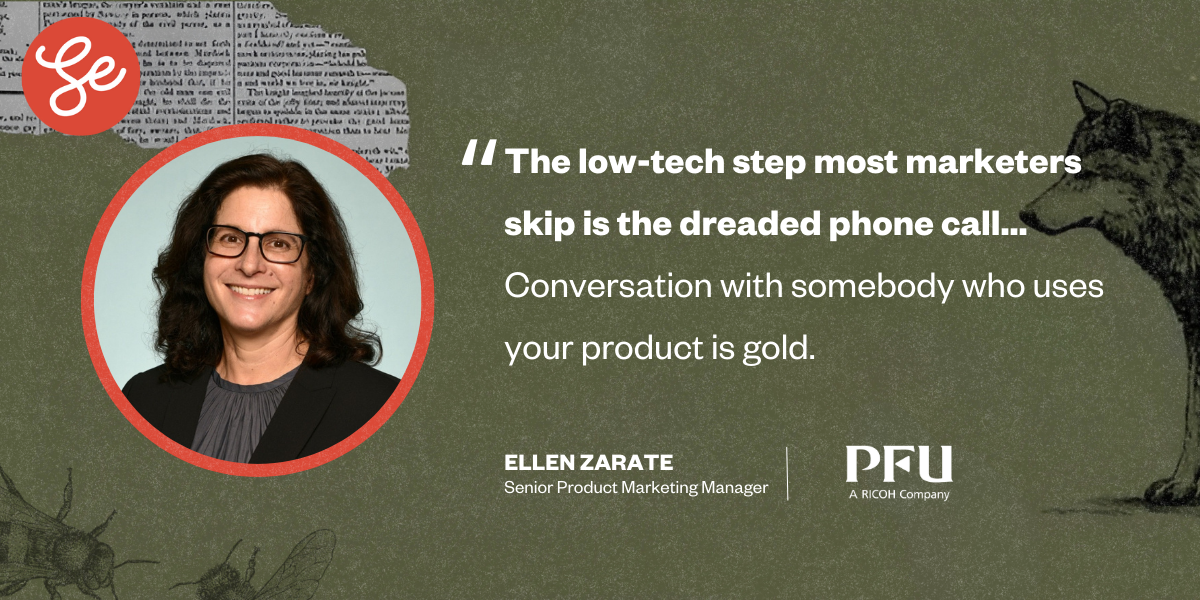
"It's really important to still go low tech sometimes. I think the two words that I've probably said the most over the course of this conversation are trust and care… You should care deeply, first, last, and in between about the people who rely on your products. Put them first in absolutely everything you do. Never change that. Engage with them every chance you get… Really and truly the lowest tech step that most marketers skip is the dreaded phone call. But I love them because if you have a conversation… with somebody who uses your product, that is where the gold lies. And you learn the things about them as people that you can fold into your messaging, into your positioning, into your products, into everything about your offering that helps your customers feel seen, valued, appreciated, and improved by what you are offering."
This is exactly how Superhuman built a strategic moat in one of the most commoditized categories in tech. Despite being a software company, they initially required a mandatory, 1-on-1 concierge onboarding call with a real human for every new user. To an efficiency-obsessed manager, this sounds insane. But these calls allowed Superhuman to teach users exactly how to use the product (retention) while simultaneously gathering deep, qualitative data on why they bought it (acquisition insight). This "unscalable" investment created a legion of superfans and provided the precise language needed to market the product effectively to others.
Make Chaos Your Ladder
Finally, the rigidity of the annual marketing plan is dead. The rate of technological change means that the "best practices" of January are often obsolete by June. Zarate advises leaders to stop fearing this chaos and start "making it their ladder," something PFU America Inc., has assisted its customers with. This means fostering a culture of rapid experimentation where failure is viewed as data collection. Marketing teams need permission to "go nuts"—to test new AI tools, try new channels, and break old workflows without the immediate pressure of ROI. In a fluid landscape, the organization that learns the fastest wins.
"Marketers should be experimenting with absolutely everything, right? AI arrived on the scene for all of us at about the same time. We are all finding our way around it. Take advantage, be bold, take risks, make chaos your ladder, right? This is a thrilling time to be in marketing because… we are only as limited as our creativity right now. So if you are doing the same old thing and doing the same old tactics, you are absolutely falling behind."
Zapier operationalized this "chaos" beautifully when the generative AI wave broke. Instead of forming a committee to study it for six months, they declared a "Code Red" and launched a company-wide internal hackathon. They encouraged every employee, technical or not, to build AI agents to solve their own problems. This didn't just result in new product features; it fundamentally upskilled their entire workforce overnight and uncovered efficiency gains that top-down planning never would have found. They didn't wait for the map, they started walking.
Win Trust in an Inhuman Era
The future of marketing isn't about choosing between the algorithm and the human, but knowing which seat each should occupy. As Zarate makes clear, the winners of the next decade will be the ones who use the machine to clear the path, but let the human walk it. By automating the drudgery, tearing down gates, and doubling down on "unscalable" human connection, leaders can build a brand that is immune to the rising tide of slop. If you want to know more about taking the drudgery out of your day-to-day work, check out PFU America, Inc. and follow Ellen Zarate on LinkedIn.
And If you're ready to build a marketing engine that scales trust as fast as it scales content, contact Splendid Engines today.
Comments