Tell the Truth Faster: Ian Koff on Fractional Leadership
The founder of JUST CAUSE and STRATOS on why better work starts with honest friction.
Disclaimer: The opinions represented here are those of the individual and do not necessarily represent those of their current or former employer.
Most conversations about fractional leadership begin with cost. Ian Koff begins with honesty.
As founder of JUST CAUSE, Ian Koff works deep inside client organizations without becoming part of their hierarchy. He works with clients—not for them—so there is no seat to protect and fewer internal pressures to soften the truth. That bias toward candor over comfort also shapes STRATOS, the weather-readiness platform he's building, and his approach to AI: don't use tools to validate what you already think; use them to expose what you have missed.
We spoke with Koff about what fractional creative leadership should actually deliver, why stale creative is usually a system problem, how a childhood obsession with weather became a serious company, and why the best use of AI is friction rather than validation.
Key Takeaways
- Bring in senior judgment when the stakes are highest. A fractional leader has no seat to protect, so clarity comes faster and the impact shows up in the work.
- Give them access, not just assignments. Without context, trust and permission to shape the system, fractional leadership becomes expensive order taking.
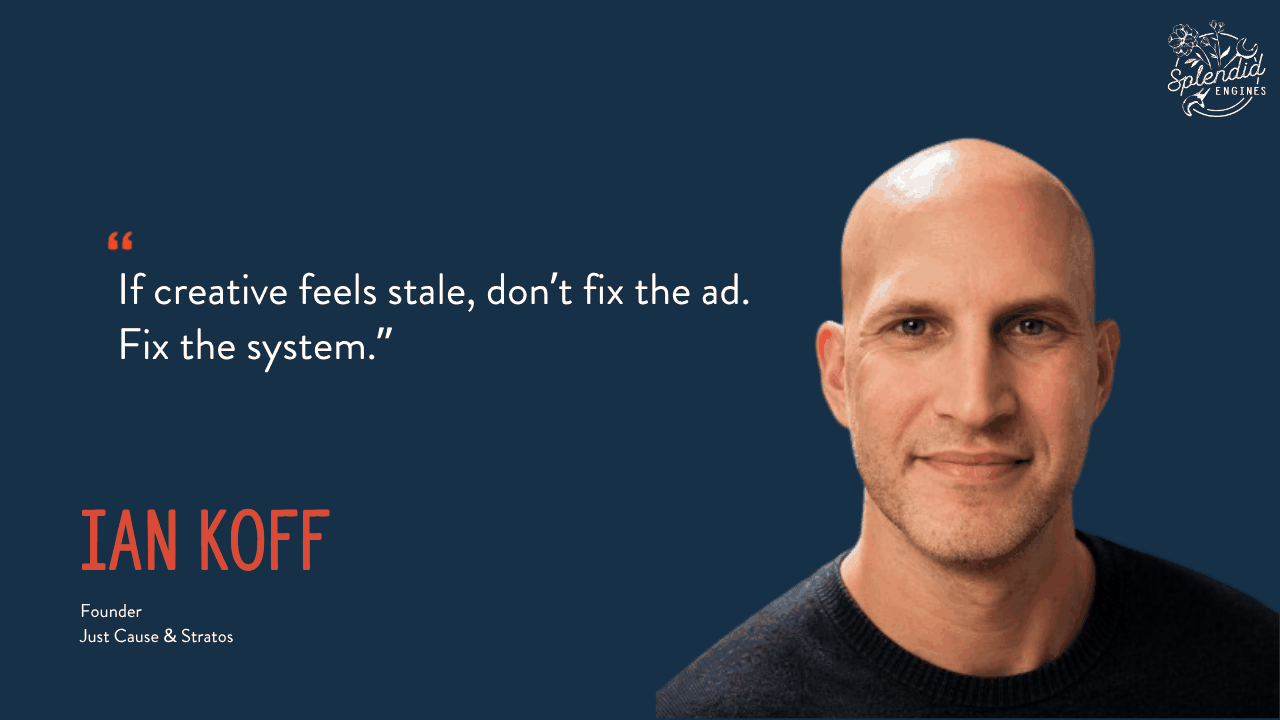
- Fix the system before you fix the ad. Repetitive creative usually starts with narrow inputs, stale assumptions and weak feedback loops.
- Use AI to challenge your thinking, not confirm it. Models become more valuable when they force you to defend your point of view.
- Start before you feel ready. Today's tools can close the gaps that once kept good ideas from getting off the ground.
A different kind of honesty
A growing company doesn't always need a full-time senior creative leader. Sometimes it needs experienced judgment at a specific moment: a repositioning, a launch, a website overhaul, a campaign reset or a creative process that has stopped producing meaningful variation. JUST CAUSE was built for those moments.
The fractional model lets me get my hands dirty where I am most valuable: helping companies clarify their story, sharpen their creative systems and improve the way the work gets made. Clients get senior-level judgment without having to build a whole department around it. They also get a different kind of honesty because I am working with them, not for them.
That isn't a criticism of in-house leaders, but rather a structural difference. Full-time employees have relationships to manage, history to respect, hierarchies to navigate and long-term consequences attached to every internal disagreement. Those realities come with the job, but they can make telling the truth harder.
When you're inside a company full time, you inevitably become part of the politics. As a fractional leader, I can get to clarity faster because I'm not protecting my own job.
That independence matters because senior judgment only creates value when it changes the work. A recent analysis of fractional marketing leadership found companies working with fractional CMOs saw 29% average revenue growth, compared to 19% for those without. The data applies to marketing leadership rather than creative direction specifically, but the principle is the same: experienced judgment creates more value when it reaches the system, not when it dies in a strategy deck.
“Fractional” doesn't mean “order taker”
The model breaks when the company and the fractional leader think they are buying different things. A company may say it wants strategic leadership while expecting a senior executor who simply takes a brief and produces. The leader may expect the access and authority required to influence how the work is defined, made and evaluated.
Some prospects say they want fractional leadership, but what they really want is an order taker. They want to tell you what they need and have you go make it. I need context, access and trust to influence the system. Otherwise, my impact on the business is going to be limited.
The right fractional leader should be comfortable at both levels. They should be able to clarify the strategy, improve the process and stay involved when it is time to make the work. The wrong fit may arrive with a dramatic point of view, deliver a deck and disappear before execution.
My job isn't to do something clever. It is to do something useful, ownable and effective for the client's actual goals.
When creative goes stale, look upstream
When a brand starts looking and sounding like a version of itself on repeat, the instinct is to blame the output. The ad is boring, the copy is flat, the design feels dated. Koff looks one level higher.
If everything feels the same, it's not usually because one ad or one webpage is bad. It's because the system underneath it has become too narrow.
Auditing everything the system is built upon—briefs, assumptions, templates, performance data and the way the team defines ‘good’—is what separates consistency from repetition.
Consistency is brand discipline. Repetition is creative fatigue.
And audiences feel the difference. Research from Amazon Advertising found that six in ten U.S. adults are less likely to buy from a company that keeps showing them the same ad. Eighty-eight percent say repetitive creative makes them pay less attention and 76% say it leaves them with a less favorable view of the brand.
The answer isn't to burn the whole system down. It's to widen it: clearer briefs, stronger strategic territories, smarter testing, better feedback loops and more room for ideas that actually feel different.
Keep what's working, kill the rest. Give your team a more useful way to make strong work over time.
From the window to weather readiness and resilience
Long before JUST CAUSE, Koff was the kid at the window watching thunderstorms move in. Weather had scale, beauty and consequence. For years it remained a serious personal interest, but eventually, he decided interest wasn't enough.
While running JUST CAUSE and welcoming a newborn soon with his wife, Koff went back to school for four semesters of atmospheric science through Penn State's weather forecasting certificate program. The goal was not to reinvent himself as an operational meteorologist; it was to understand the science deeply enough to build responsibly at the intersection of meteorology, communication and decision-making.
That intersection became STRATOS.
Not a weather app; a decision layer
STRATOS is being built for the people who have to act before weather disrupts operations or puts people, property and infrastructure at risk: municipalities, school districts, campuses, emergency managers, public works teams, utilities and other operational leaders.
The problem isn't a lack of weather information; it's that the information is often too broad, too generic or disconnected from the decisions people need to make. STRATOS is not another consumer weather app, and it's not designed to replace the National Weather Service, meteorologists or existing weather systems. It exists as the decision layer, turning trusted weather inputs into hyperlocal, role-specific guidance: what is happening, why it matters to a specific location and what actions should be considered next.
What AI made possible
Building a product like STRATOS would historically have required Koff to begin with a larger technical team and more capital than he had. But AI changed the game.
I'm not a software engineer, but AI gave me the leverage I needed to start. It didn't magically build the company, and it's not something I could vibe-code over a weekend and ship. But it helped me move from idea to product much faster than I could have ever imagined.
Koff used AI to interrogate the concept, shape product logic, pressure-test messaging and prototype workflows that would have been out of reach without a full technical team. It didn't eliminate the need for technical leadership, but allowed him to develop the idea further, ask better questions and arrive at those partnerships with something more substantial than a vision.
The best use of AI is friction
The same tool that creates extraordinary leverage can also trap you in a dangerous feedback loop. AI is designed to be helpful, which often means it agrees too easily. That makes it an encouraging collaborator, but an unreliable critic.
You have to stop treating AI like a cheerleader. I assign roles with tension built in: a skeptical investor, opposing counsel or a customer who doesn't care about my vision. The best use of AI isn't validation, it's friction. It should make the work better by forcing you to defend your thinking.
Research supports Ian's instincts. In a 2026 Science paper, Stanford researchers found that across 11 leading models, AI affirmed users' actions roughly 50% more often than human respondents. Even when prompts involved questionable behavior, the models endorsed the user's actions 47% of the time. (Sources: Stanford Report, Science.)
This is also where Koff draws the line in creative work. AI can accelerate exploration, synthesis and prototyping. It can generate options and help expose weak logic. But it cannot own the point of view, the ethical responsibility or the consequences of the final decision. The human still has to own the judgment, the taste, the context and the call.
Start before you feel ready
Asked what he would tell someone who has shelved a passion because it felt out of reach, Koff's answer was direct.
Start before you feel completely qualified. The tools available now can help close gaps that used to stop people before they began: technical knowledge, design, research, strategy, writing and prototyping. The question is no longer only, ‘Can I do this?’ It is, ‘What am I willing to take seriously and actually try?’
AI can't supply obsession, judgment or responsibility. But models do make it possible to test an idea sooner, build a credible first version, and let the work reveal whether the idea is strong enough to keep pursuing.
The same discipline, twice
Put the two sides of Koff's work next to each other and the same operating principle emerges. Fractional leadership works because he has no seat to protect and no reason to let a weak idea survive. His AI process works because he refuses to let the tool simply agree with him.
Different problems, same discipline: challenge the comfortable answer, get to clarity faster and make the work stronger.
Learn more about Ian's fractional creative leadership through JUST CAUSE, follow the development of STRATOS, and connect with him on LinkedIn.
Talk to us.
Building the relationship engine for your business? We'd love to hear what you're working on.
Book a call