Susan Arendt on Why Attention Is Earned, Not Owed
Highwire's Content Director on why content is just people trying to reach people, and what that means for teams drowning in AI-written noise.
Disclaimer: The opinions represented here are those of the individual and do not necessarily represent those of their current or former employer.
Every team can now make more content, faster, than ever before. AI writes the sentences. The tools fill the calendar. So why does so much of it land with a thud? The answer is simple, and it is easy to forget when the pressure is on: your audience does not owe you their time. You have to earn it. For revenue leaders staring at flat pipeline despite churning out more content than ever, that shift in mindset is the whole ballgame.
We spoke with Susan Arendt, Content Director at Highwire, about what changes when you treat content as a way to connect with people instead of a machine for making leads. Susan has spent years leading creative teams and editing the kind of work people actually want to read. Her take cuts against a lot of what passes for content strategy right now.
Key Takeaways
- Earn the attention you ask for. Nobody owes you their time. Every piece has to give something back before it takes.
- Stop running creative teams like machines. Constantly pushing for more output is self-defeating. "Productivity" and "output" are not synonyms. There is no free speed.
- Help, even when the topic is boring. Dry topics still pull their weight when the content actually solves the reader's problem.
- Drop the funnel-as-a-line idea. Buyers arrive from everywhere, already deep in their own research. Meet them there.
- Learn the hard way before you use the easy way. AI is a real tool, but it writes beautiful sentences that say nothing unless you know better.
For more on how earned trust shapes modern GTM, see our Trust Gap research.
Content is one person trying to reach another
Strip away the strategy decks and the funnel maps, and content does one thing. It carries a message from someone who has something to say to someone who might want to hear it. That is it. When Susan describes her work, she keeps coming back to that human core.
"Content is just to connect people. The intent is always the same. It is one person wanting another person to hear them. And I have to say it to you in a way that you are willing and able to hear it. That's what content is, whether it's an opinion piece, an explainer, a piece of social media, a video, or a podcast. The vehicles change, the language changes, the audience changes, but it's the same at its core."
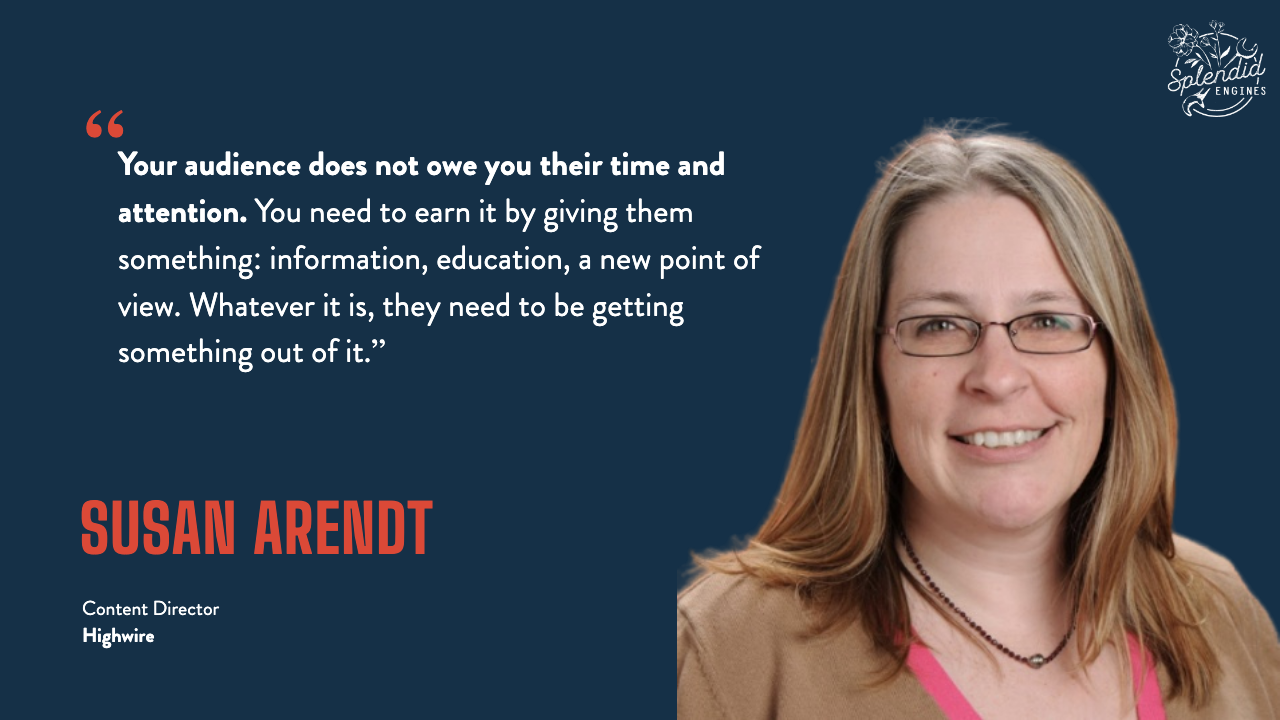
That framing changes how you judge a piece. Stop asking "will this convert" first, and start asking "why would anyone stop and pay attention to this." As the saying goes, a piece of content for everyone is a piece of content for no one. Susan agrees, and pushes it further: your audience does not owe you their time and attention, so you have to earn it by giving them something. Content that respects the reader builds the kind of trust that turns into real conversations later.
You cannot run a creative team like a machine
There is a strong pull, especially now, to treat creative people like content dispensing machines. Pull the lever, a thing comes out. Pull it faster, more things come out. Susan has watched what happens when a team is pushed that way, and the numbers did not lie.
"We had to crank up the amount of output our writers put out for a quarter. They had to increase their output by 20% a week. They were fine for about the first month. And then very, very clearly their quality dropped, and it required more revisions. So there was no time saved, there was no money saved. Increasing their output did not lead to any kind of increase in productivity. You cannot treat creativity like a limitless resource. It has to be refilled."
More volume, same total value, plus a tired team. The broader picture backs her up. Superside's 2026 research found that 78% of creative leaders say demand already outstrips their team's capacity to deliver. Push past that line and the work does not get faster, it gets sloppier, and the revisions eat the time you thought you saved. Susan's rule is worth taping to the wall: kindness and excellence are not mutually exclusive. The best creative output comes from teams that are challenged, not crushed.
Want to learn more? Get in touch with Splendid Engines to learn how our GTM engine can power your business.
Boring B2B content still wins if it's actually helpful
Plenty of B2B topics are, to be blunt, not thrilling. SOC 2 compliance is never going to set a heart racing. But the person searching for it has real money on the line, and getting it wrong can be financially devastating. That is the reframe Susan wants content teams to make. Boring is not the same as unimportant. Someone came looking for this on purpose, and the only job that matters is helping them better than anyone else does.
"One of the biggest skill sets you need to develop as a content marketer in B2B is the ability to be interested in anything. There is an interesting aspect to literally everything we write about, even if it's only in the way it impacts the person at the other end. It's not a subject problem. It's not a strategy problem. Some things are just the vegetables of the content world. Does everybody love kale? No. Is it good for you? Yes."
The skill Susan talks about here is intellectual curiosity, and it's a shared trait among some of the best B2B content writers we've ever been around. Find the real problem the reader has and help them solve it. Some call this "competitive helping," and it holds up. Susan pointed to work she did for a self-care industry client that ran a simple, honest ranking of the "five best med spa ads." It is a niche topic and not necessarily the flashiest assignment, but it sat at the number one spot on SERPs for years because it was genuinely useful. Nobody clicked it for the entertainment. They clicked it because it answered their question better than anyone else. That is the bar. Be the most helpful voice in a boring category and you own it.
The funnel stopped being a straight line
Plenty of teams still picture the funnel as a tidy path: awareness at the top, a purchase at the bottom, everyone walking the same route. That map no longer matches how people buy. By the time someone reaches out, they have usually done their own research across half a dozen channels and arrived with an opinion already formed. If your content only shows up at the "top" of a funnel that no longer exists, you miss them at the moment they are actually deciding.
"Stop treating the funnel like it's a linear journey. It's not. Top of funnel is not literal anymore. That's still the person who needs information, who's still fact-finding. But it's a category now, as opposed to a destination. So think of the funnel more as categories of content, as opposed to the way the user is actually going to go. Because that journey just doesn't exist anymore. They're coming in through Reddit, social, YouTube, a podcast, a Substack. And they're coming in typically much further down funnel."
Buyers do their own research now, across many channels, long before they ever raise a hand. Gartner's work on the B2B buying journey says the same thing: buying is a set of looping jobs, not steps, and 75% of B2B buyers actually prefer a rep-free experience. The takeaway for marketing leaders is practical. Stop forcing every reader onto one path, and start showing up helpfully wherever they already are. That means better attribution thinking and content that works even when it is someone's first touch and their last.
AI is a tool you have to earn the right to use
Susan is not anti-AI, but she isn't telling anybody they have to use it either. With more creatives being pressured to fold AI into their workflows, her point is about how to do it well if you do, not whether you should. She is clear-eyed about what it does well and where it fails. She uses a hilarious analogy to illustrate the point. It's like a microwave, she says. Great for popcorn, useless for a steak. The trouble is that a microwaved steak still looks like dinner. Hand the tool to someone who knows the craft and it makes them faster. Hand it to someone who doesn't and it floods the page with sentences that read well and mean nothing.
"Knowing what AI is better suited for in content creation, and using it for that, is very helpful. It can take some of the pressure off the creative process. But you also have to know what it is not best suited for. And you have to know how to do it the hard way in order to be able to take advantage of using it the easy way."
That is the part teams miss when they hand strategy to a tool. AI can polish, speed up, and draft. It cannot tell you what is worth saying. The people who get real leverage from it are the ones who already know the craft. So build the muscle first. Learn to write, edit, and think without the tool, then let the tool make you faster. Used that way, AI is a genuine advantage. Used as a shortcut around the thinking, it just fills the internet with more sentences nobody asked for.
The best content is worth something on its own
Every thread here ties back to one idea. Teams get fixated on what a piece has to do for them, which number it has to move, and they forget the reader has to care first. Susan's rule is that a piece has to be worth something even if it never converts.
"They forget that it has to serve an audience. The audience has to care. The best teams know that this thing needs to have value in and of itself. Even if it doesn't convert, even if it doesn't do the thing it's supposed to do, it needs to be good content by itself. Inevitably, the teams that go in with that attitude perform better."
Susan's throughline is a good one to sit with. If you want to see more of her thinking, follow Susan Arendt on LinkedIn or check her out on Bluesky, mostly posting about horror movies, video games, and her adorable dogs.
Building the relationship engine for your business? Get in touch at splendidengines.com/contact.
Talk to us.
Building the relationship engine for your business? We'd love to hear what you're working on.
Book a call